Justice Emmett Hall and the Foundation
The Foundation was created in 1997 to preserve the memory of Justice Emmett M. Hall, a father of Canadian Medicare, and to carry forward his belief in universal and accessible health care.
18981995
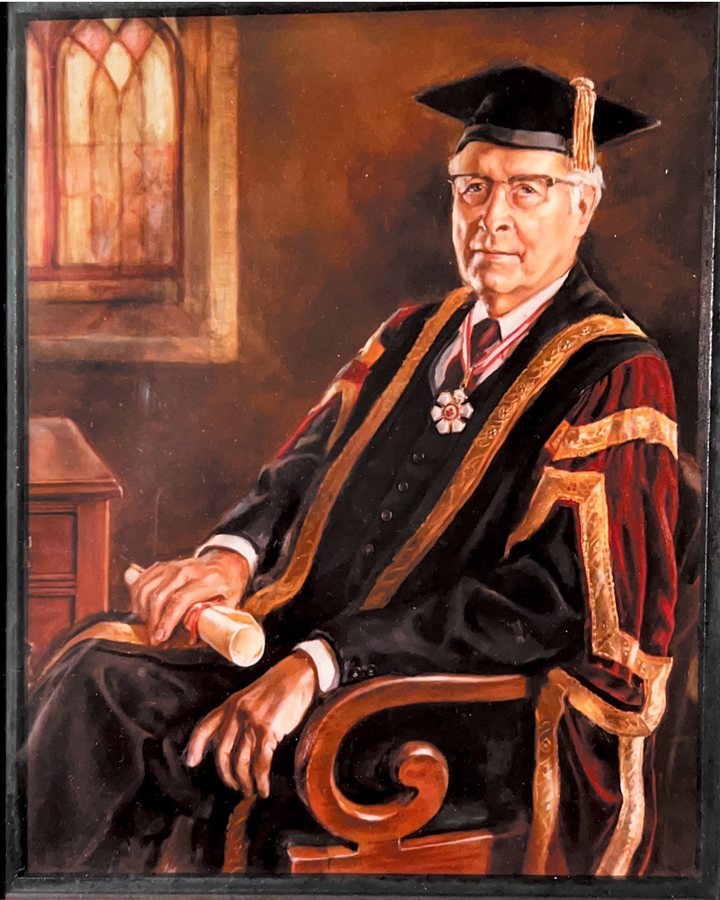
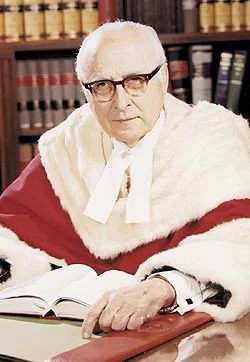
Justice Emmett Hall
Emmett Hall was born on November 9, 1898, at St. Colomban, north of Montreal, into a poor family of eleven children. His father moved the family to Saskatoon for a homestead land grant and the promise of free university education. Hall studied law at the University of Saskatchewan, graduated in 1919, and practised law in Saskatchewan for the next 35 years. He ran twice for elected office as a Conservative and was defeated both times.
In 1957, at 58, he was appointed Chief Justice of the Court of Queen’s Bench for Saskatchewan, shortly after the election of the Progressive Conservatives under his old law-school colleague John G. Diefenbaker. He became Chief Justice of Saskatchewan and was later named to the Supreme Court of Canada.
The Royal Commission on Health Services
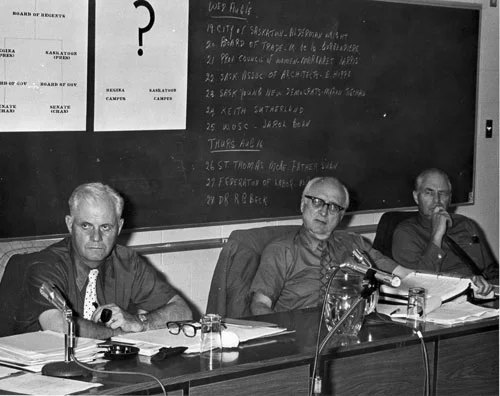
In 1961 Prime Minister Diefenbaker asked Hall to lead the Royal Commission on Health Services, which he conducted amid a firestorm over the introduction of universal medical care insurance in Saskatchewan. The commission reported in 1964 to the Liberal government of Lester Pearson. To the surprise of many, it recommended a universal, single-payer model similar to Saskatchewan’s, not only for medical care but for a broad range of other health services, building on the universal hospital insurance most provinces had introduced a few years before.
The federal government was deeply divided on how and when to introduce Medicare. The Hall report contributed significantly to the Pearson cabinet’s decision to share the cost of Medicare with provinces that adopted a universal, single-payer model. For this, Hall has often shared the title of father of Medicare with Tommy Douglas, the Premier of Saskatchewan.
The Supreme Court and beyond
Hall joined the Supreme Court of Canada during the Royal Commission. Known as a hard-working and decisive judge, he took part in a number of landmark cases. His minority judgment in the 1973 Nisga’a land claims case strongly influenced Prime Minister Pierre Trudeau, who afterwards opened claims negotiations with Indigenous peoples.
Hall continued his public policy work through federal and provincial commissions, both on the bench and in retirement. In 1979 the federal government asked him to review Medicare. His report the following year, and his concerns about the growing use of extra billing and user fees, were an important catalyst for the Canada Health Act of 1984.
One of his biographers called Emmett Hall an establishment radical. Although he became a member of Canada’s privileged elite, he put social justice ahead of position and believed deeply that all Canadians should have access to basic health care on the same terms and conditions, without financial barriers. He died on November 12, 1995.
Further reading
- Dennis Gruending, Emmett Hall: Establishment Radical (Toronto: Fitzhenry and Whiteside, 2005).
- Frederick Vaughan, Aggressive in Pursuit: The Life of Justice Emmett Hall (Toronto: University of Toronto Press, 2004).
- Dennis Gruending, “Emmett Hall,” The Encyclopedia of Saskatchewan.
The Foundation
Vision
Canada’s health system will embrace and advance the ideals of Justice Emmett Hall and the core principles of equity, fairness, justice and efficiency for all Canadians.
Mission
The Foundation supports and celebrates excellence among those leading, undertaking or communicating health services and policy research that advances the ideals of Justice Emmett Hall.
History
The Foundation was conceived in 1996 at a Vancouver meeting of the Canadian Health Economics Research Association (CHERA), the predecessor of CAHSPR. It was incorporated on May 5, 1997 under Saskatchewan’s Non-profit Corporations Act and became a registered charity on November 24, 1997.
Its first purpose was to create the Hall Memorial Lecture and to raise a capital fund large enough to finance the lectureship from its earnings. Under the leadership of Past President Marion Jones, the Foundation added three student essay awards, renamed the Jack Boan Student Essay Awards in 2015.
Governance
The Foundation is governed by a board of directors. Members are fully paid members of CAHSPR and may propose and vote on motions at the annual general meeting, which usually takes place at the CAHSPR conference.
Board of Directors, 2025–26
- President
- Sophia Myles
- Vice-President
- Owen Adams
- Treasurer
- Lindsay Hedden
- Past President and Secretary
- Maria Mathews
- Student Member
- Gillian Young
- Director
- Rebecca Correia
- Director
- Mark Dobrow
- Director
- Christian Rochefort
- Director
- John Sproule
- Director
- Amy Zarzeczny
- Ex officio, CAHSPR representative
- Maggie Keresteci
- Ex officio, Hall family representative
- Charlotte Wedge
Annual reports
Equity, diversity and inclusion statement
The Hall Foundation is committed to a diverse, inclusive and equitable environment where all Board Directors, Foundation members, award nominees, student applicants and the public feel respected and valued regardless of gender, age, race, ethnicity, national origin, sexual orientation or identity, disability, education or any other bias. The Foundation is committed to being non-discriminatory and to providing equal opportunities for advancement in all areas of our work. We respect the value that diverse life experiences bring to our Board and membership, and we strive to listen to and value their views. The Foundation is committed to modelling diversity, inclusion and equity and to maintaining fair and equitable treatment for all.